Employee Wellness
Protecting Your Benefits: A Clear Guide to HSA, FSA, LPFSA, and HRA
Why Understanding Your Benefits Matters
Benefits can feel confusing and tedious until you realize how useful they can actually be. They're real tools that can save you money and give you practical support when you actually need it. Knowing the difference between an HSA, FSA, LPFSA, and HRA helps you make clearer decisions instead of guessing or hoping the system works itself out.
When people understand how these accounts work, they get more value out of them. They know when to use each one, what qualifies, and how to avoid losing funds. The goal is simple: make benefits easy to use so they actually work for you when it matters.
What an HSA is and When It Works Best
An HSA is a Health Savings Account. You can only use one if you're on a High Deductible Health Plan (HDHP), so it starts with the type of insurance you have. But once you qualify, it becomes one of the strongest tools you can use.
It lets you save your own money tax free and use it any time for medical needs. That includes emergencies, long term health planning, and even future vision care. The money you don't use stays in the account and rolls over each year. You keep it even if you change jobs.
It works best when you want control of your health dollars and when you plan ahead instead of reacting after something goes wrong.
What an FSA is and How it Helps With Predictable Costs
An FSA is a Flexible Spending Account. You decide how much to set aside for the year and that full amount becomes available right away. The catch is that it usually follows a "use it or lose it" rule. If you do not use the funds by the end of the plan year they may expire.
That makes it ideal for planned expenses like annual checkups, prescriptions, dental work, and vision care. If you already know you are going to need new glasses or a routine eye exam, this account helps you pay for it without waiting or guessing on cost. It puts structure around your spending and keeps medical costs predictable.
What a Limited-Purpose FSA (LPFSA) Does
A Limited Purpose FSA works alongside an HSA. If you already have an HSA, this account gives you a dedicated bucket just for vision and dental expenses. It keeps your HSA focused on long term medical needs while still giving you a way to cover things like prescription glasses, eye exams, and prescription safety eyewear right now.
Think of it as a targeted tool. It is designed for people who want to protect their health savings but still take care of their eyes and teeth without dipping into their main HSA balance.

What an HRA is and When Employees Benefit From it
An HRA is a Health Reimbursement Arrangement. It is fully funded by the employer and does not require any money from the employee. When a qualified medical expense comes up, the employee submits it and the HRA helps cover the cost based on the rules of the plan.
It works well when a company wants to support health needs without asking employees to budget ahead of time. Since the funds stay with the employer, this account is not something you take with you if you leave, but while you are here it can make care much more accessible.
It is simple. No personal contribution. Less pressure on budgeting. More support when something comes up.
Side-by-Side Comparison: The Four Accounts
Here's a fast way to see how each account works. The focus is on who owns it, whether unused money rolls over, what it can cover, and how it affects your paycheck.
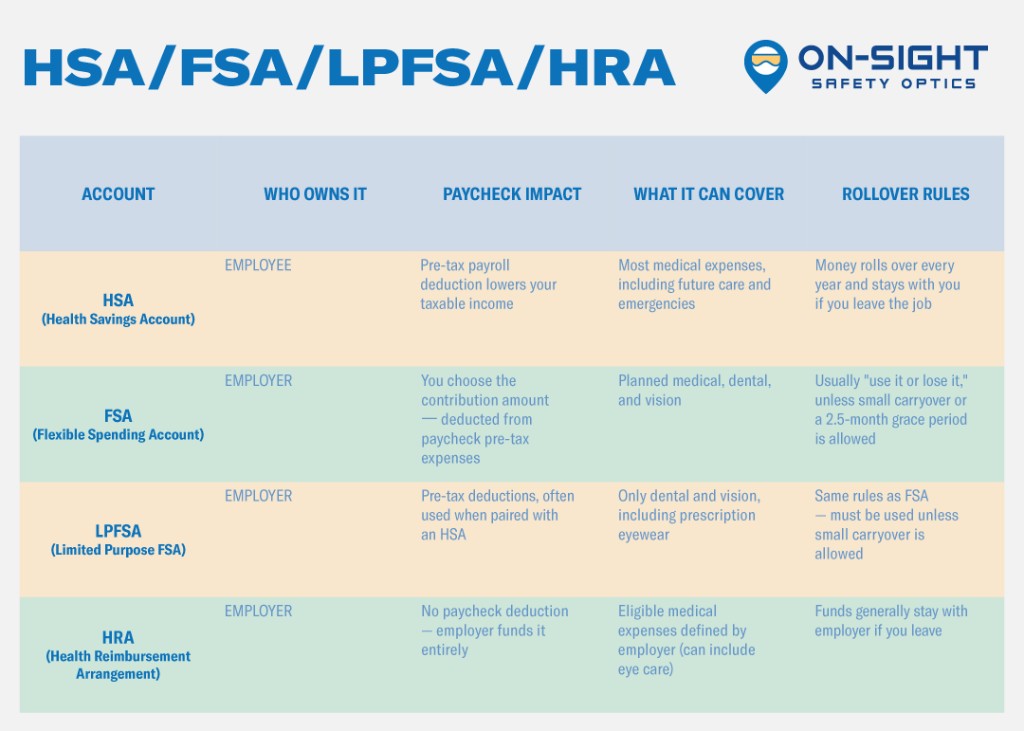
This layout helps employees see where each account fits and which one supports their situation best. It also shows how different accounts can work together instead of replacing each other.
How to Use Your Benefits
Here's what to do when you're ready to use your plan for eyewear or vision needs:
- Verify what your plan covers, for example, prescription lenses, safety glasses, coatings, dental or vision exams.
- Ask the retailer for an itemized receipt that lists each service or product separately (frames, lenses, coatings, safety specs).
- Keep a copy of your receipt and any prescription or eyewear upgrade note. Some plans require you to submit documentation.
- Confirm your deadline to use the funds. For many FSAs it is December 31st; HSAs may roll over but restrictions vary.
- Match expense to account type. If you are using an HSA, FSA, LPFSA, or HRA, make sure you pick the right one so your reimbursement goes smoothly if needed.
How These Accounts Support Safe, Clear Vision
Each of these benefit accounts can be used toward eye exams, prescription glasses, safety eyewear, and vision upgrades. That means employees often already have the funds to protect their vision. They just need to know which account to use and when.
Clear vision is not just about comfort. It plays a direct role in safety, focus, and job performance. When employees can see clearly, they move more safely, work with more precision, and make fewer mistakes. Using these benefits well is one of the simplest ways to support a safer workplace.

Choosing the Right Setup for Your Needs
The best setup depends on how you use your health benefits and what you want to prepare for. Start with your health plan, then look at your spending habits and what you expect in the year ahead.
- HSA: If you have a high deductible health plan and want long term savings plus emergency backup, an HSA usually makes the most sense. It lets you build that savings over time and keep it if you change jobs.
- FSA: If you already know you will have regular medical, dental, or vision expenses, an FSA can cover those planned costs and give you the full amount upfront.
- Limited Purpose FSA: If you want to keep your HSA growing but still need support with dental and vision care, a Limited Purpose FSA keeps those expenses separate and focused.
- HRA: If your employer offers an HRA, it can reduce the pressure of out-of-pocket costs and give you help when something comes up even if you did not plan for it.
There is no one right answer for everyone. Some people benefit from a combination. The key is knowing what you have and using it in a way that matches your health, your budget, and your goals.
Final Takeaway: Protecting Your Vision Starts With Understanding Your Benefits
Clear vision and strong safety go hand in hand. Most employees already have access to funds that can support eye exams, prescription eyewear, and safety glasses. They just need to know which account to use and when. When benefits are understood and used well, they stop feeling like paperwork and start working like real support.
Protecting vision is not just a health decision but a safety decision. Knowing your benefits is the first step to using them with confidence.
HSA and FSA cards work at our San Diego showroom for prescription glasses, including prescription safety glasses.
Further Reading
What Exactly Are Safety Glasses? Understanding Z87, ANSI & OSHA Standards
What Z87 and ANSI Z87.1 mean, how OSHA enforces eye protection, when Z87+ is required, and how safety eyewear requirements vary by industry.
Anti-Reflective: Is It Really Necessary?
What AR coating actually does, when it makes a difference, and how it changes the way you see at work, on the road, and at home.
Why UV Protection Still Matters on Cloudy Days
UV light reaches your eyes even when the sky is overcast. Learn how UVA and UVB differ, why cloudy days are misleading, and how to protect your vision every day.
Get Prescription Safety Eyewear
Walk into the San Diego showroom to try frames on with a licensed optician, or set up an on-site program for your team.